
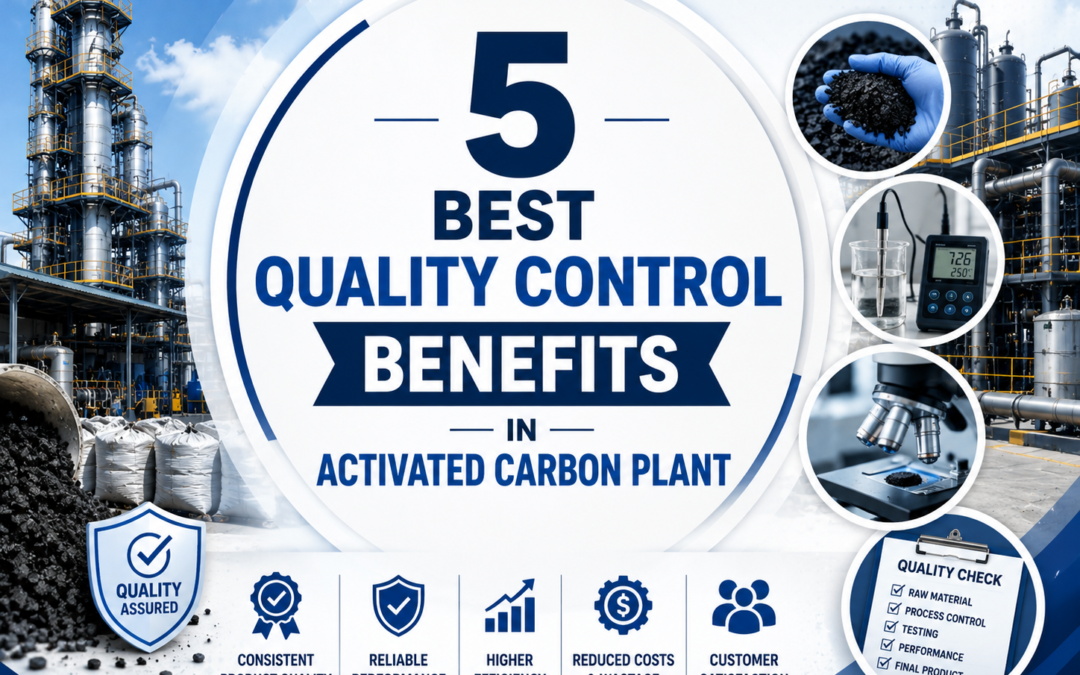
5 Best Quality Control Benefits in Activated Carbon Plant
5 Best Quality Control Benefits in Activated Carbon Plant are essential for manufacturers that want to produce consistent, high-performance activated carbon while maintaining efficient production and customer satisfaction. Activated carbon is widely used in water treatment, air purification, chemical processing, food and beverage industries, pharmaceuticals, mining, and many other applications. Because the performance of activated carbon depends heavily on its physical and chemical properties, maintaining strict quality standards throughout manufacturing is extremely important. For manufacturers such as Technomart India, quality control is not simply a final inspection; it is an important part of the entire production process.
A reliable activated carbon plant must carefully control raw materials, carbonization, activation, cooling, screening, grinding, packing, and storage. Even a small variation in one stage can affect adsorption capacity, moisture content, ash content, particle size, hardness, and other important characteristics of the final product. This is why understanding the 5 Best Quality Control Benefits in Activated Carbon Plant can help manufacturers build a more reliable and productive manufacturing system.
What Is Quality Control in an Activated Carbon Plant?
Quality control refers to the systematic procedures used to monitor, test, and maintain the quality of activated carbon during manufacturing. It begins with selecting suitable raw materials and continues through every stage of production until the finished product is packed and delivered.
Depending on the application, activated carbon may need to meet different specifications. Important quality parameters can include iodine number, methylene blue value, moisture content, ash content, bulk density, hardness, particle size distribution, and adsorption performance.
A well-designed manufacturing system makes it easier to monitor these parameters consistently. The 5 Best Quality Control Benefits in Activated Carbon Plant demonstrate how effective quality management can influence the complete manufacturing operation.
Why Is Quality Control Important in Activated Carbon Manufacturing?
Activated carbon is an adsorption material, which means its performance depends on its pore structure, surface area, chemical properties, and physical characteristics. Customers generally purchase activated carbon for a specific purpose, so inconsistent quality can reduce performance and increase operating costs.
For example, activated carbon used for water purification may require different characteristics from carbon used for gold recovery or industrial gas treatment. Therefore, manufacturers must maintain appropriate production parameters according to the intended application.
The 5 Best Quality Control Benefits in Activated Carbon Plant help manufacturers maintain product consistency while reducing unnecessary production losses and improving overall operational efficiency.
1. Consistent Activated Carbon Quality
The first and one of the most important benefits of quality control is product consistency. Customers expect every batch of activated carbon to perform according to the agreed specifications.
Variations in raw material quality, activation temperature, residence time, steam flow, cooling conditions, or particle size can result in differences between batches. A strong quality-control system helps identify these variations before they become major production problems.
Regular testing and monitoring allow manufacturers to compare production results with established specifications. If a batch shows unusual characteristics, corrective action can be taken before the product reaches the customer.
This is one of the key reasons the 5 Best Quality Control Benefits in Activated Carbon Plant are important for long-term manufacturing success. Consistent products can help manufacturers build customer confidence and establish a stronger reputation in competitive markets.
For Technomart India, the focus on reliable plant design and process efficiency can support manufacturers in creating controlled production environments where important manufacturing parameters can be monitored systematically.
2. Better Adsorption Performance
The second major benefit is improved and more predictable adsorption performance. Activated carbon works because of its highly developed porous structure and large internal surface area. The quality of this pore structure is strongly influenced by carbonization and activation conditions.
During production, factors such as temperature, activation time, airflow, steam quantity, and raw material characteristics can affect pore development. If these parameters are not properly controlled, the final activated carbon may not deliver the expected adsorption performance.
Quality control provides manufacturers with a way to monitor product characteristics and identify deviations. Testing can help determine whether the finished carbon meets the required performance specifications.
Among the 5 Best Quality Control Benefits in Activated Carbon Plant, better adsorption performance is particularly important because customers often select activated carbon based on its ability to remove specific contaminants or recover valuable substances.
For example, activated carbon used in water treatment may need strong adsorption properties for organic impurities, while carbon used in industrial applications may require specific pore-size characteristics. Maintaining consistent quality allows manufacturers to produce material suitable for different applications.
3. Reduced Production Waste and Cost
The third important benefit of quality control is reducing waste. Poor-quality production can lead to rejected batches, excessive reprocessing, material losses, and unnecessary energy consumption.
Without proper monitoring, a manufacturing problem may continue for several production cycles before it is detected. By that time, a significant quantity of raw material may already have been processed.
Quality-control procedures help identify problems earlier. Monitoring raw materials and process conditions allows operators to take corrective action before large quantities of material are affected.
This makes cost reduction another important point among the 5 Best Quality Control Benefits in Activated Carbon Plant.
Better quality control can also improve resource utilization. When activation conditions are properly controlled, manufacturers can avoid unnecessary energy use and reduce the possibility of producing carbon that requires additional processing.
Efficient production is especially important in large-scale manufacturing, where even a small reduction in material loss or energy consumption can contribute significantly to overall profitability.
4. Improved Customer Satisfaction and Trust
The fourth benefit is stronger customer satisfaction. In industrial markets, customers often require activated carbon with specific technical properties. If the delivered material does not meet those requirements, it can affect the customer’s process and lead to complaints, returns, or replacement costs.
Consistent quality gives customers greater confidence in the product. When manufacturers repeatedly supply activated carbon that meets agreed specifications, they can build long-term business relationships.
This makes customer trust one of the most valuable outcomes among the 5 Best Quality Control Benefits in Activated Carbon Plant.
A professional quality-control approach also helps manufacturers respond to customer requirements more effectively. Different industries may require different grades, particle sizes, or performance characteristics. A controlled manufacturing process makes it easier to produce and verify these different specifications.
Technomart India understands the importance of dependable industrial equipment and plant solutions. A properly engineered activated carbon plant can support manufacturers in maintaining controlled production conditions and achieving reliable output.
5. Better Production Efficiency and Process Control
The fifth benefit is improved production efficiency. Quality control is not limited to testing the finished product. It also involves monitoring the manufacturing process itself.
An efficient activated carbon plant should provide appropriate control over important production stages, including:
- Raw material preparation
- Carbonization
- Activation
- Cooling
- Crushing
- Grinding
- Screening
- Separation
- Packing
- Storage
Monitoring these stages helps operators identify potential problems and maintain stable production conditions.
This is why improved process control completes the 5 Best Quality Control Benefits in Activated Carbon Plant. When production parameters are controlled effectively, manufacturers can reduce unexpected interruptions and improve overall plant performance.
Better process control can also make production planning easier. Manufacturers can monitor output, identify recurring problems, and make informed decisions about maintenance, raw materials, and operating conditions.
Quality Control at Different Stages of an Activated Carbon Plant
Quality control should be implemented throughout the production cycle rather than only at the final stage. Each stage can influence the quality of the final product.
Raw Material Quality
Raw materials such as coconut shells, wood, coal, or other carbonaceous materials can have different characteristics. Moisture, ash content, density, and composition may vary depending on the source.
Selecting and testing raw materials can help manufacturers maintain a more consistent production process.
Carbonization Control
Carbonization converts the raw material into char under controlled heating conditions. Temperature and residence time can influence the characteristics of the resulting char.
Maintaining suitable carbonization conditions is important for achieving predictable activation results.
Activation Control
Activation is one of the most critical stages of activated carbon production. Physical activation may involve controlled heating with steam or carbon dioxide, while chemical activation uses suitable chemical activating agents.
Proper control of activation temperature, time, and other operating parameters is necessary to develop the desired pore structure.
Particle Size Control
After activation, activated carbon may be crushed, ground, and screened according to customer requirements. Particle size can influence pressure drop, adsorption rate, handling, and application performance.
Screening and separation equipment can help manufacturers maintain the desired particle-size distribution.
Final Product Testing
Finished activated carbon should be tested according to the requirements of the target application. Testing may include parameters such as moisture, ash, iodine number, hardness, bulk density, and particle size.
Final inspection helps ensure that only products meeting the required specifications are dispatched.
How Technomart India Supports Activated Carbon Manufacturing
Technomart India is associated with industrial plant and machinery solutions designed for various processing requirements. In activated carbon manufacturing, plant design plays an important role in achieving reliable production.
A suitable activated carbon plant should be designed according to the raw material, required capacity, activation method, desired product specifications, and intended application.
The equipment selection should also consider production efficiency, ease of operation, maintenance requirements, safety, and process control.
The 5 Best Quality Control Benefits in Activated Carbon Plant can be achieved more effectively when the plant is designed around controlled and repeatable production processes.
Technomart India can help manufacturers consider important aspects of plant configuration and equipment selection so that the production system is aligned with their manufacturing objectives.
Quality Control and Different Activated Carbon Applications
Activated carbon is used across a wide range of industries, and each application may have different quality requirements.
In water treatment, activated carbon is commonly used to reduce unwanted organic compounds, odors, colors, and other impurities.
In air and gas purification, carbon can be used for adsorption of specific gases and volatile compounds.
In the gold recovery industry, activated carbon is valued for its ability to adsorb gold complexes during processing.
In the food and beverage industry, activated carbon can be used for purification and decolorization processes.
In the pharmaceutical sector, specialized activated carbon may be used for purification applications.
Because requirements vary across industries, manufacturers need flexible and controlled production systems. The 5 Best Quality Control Benefits in Activated Carbon Plant become even more valuable when a plant produces multiple grades or particle sizes.
Common Quality-Control Parameters
Manufacturers may monitor several parameters depending on the intended application and applicable specifications.
Important parameters can include:
- Iodine number
- Methylene blue adsorption
- Moisture content
- Ash content
- Bulk density
- Hardness
- Particle size
- Surface area
- Pore volume
- Adsorption capacity
- pH value
Not every parameter is required for every grade of activated carbon. The testing program should be selected according to the product specification and end-use application.
The Role of Automation in Quality Control
Modern activated carbon plants can benefit from automation and improved process monitoring. Automated systems can help operators maintain consistent temperatures, feed rates, activation conditions, and other operating parameters.
Automation can also reduce the possibility of human error and make production data easier to track.
When combined with laboratory testing and appropriate process controls, automation can strengthen the overall quality-management system.
For manufacturers looking to improve productivity, automation can therefore complement the 5 Best Quality Control Benefits in Activated Carbon Plant by supporting repeatable and controlled production.
Quality Control Helps Build a Stronger Brand
Product quality has a direct influence on a manufacturer’s reputation. A company that consistently supplies reliable activated carbon can develop stronger relationships with distributors, industrial customers, and end users.
On the other hand, inconsistent quality can result in customer complaints and reduced confidence.
Quality control therefore has a role beyond manufacturing. It can become an important part of brand development and market competitiveness.
The 5 Best Quality Control Benefits in Activated Carbon Plant show that quality management can influence product performance, production cost, customer satisfaction, and business growth at the same time.
Why Choose a Reliable Activated Carbon Plant Solution?
Selecting the right plant and equipment is an important decision for any activated carbon manufacturer. The plant should be capable of supporting the required production capacity while maintaining appropriate process control.
Manufacturers should consider factors such as:
- Production capacity
- Raw material type
- Activation method
- Energy efficiency
- Process control
- Equipment durability
- Maintenance requirements
- Product specifications
- Safety features
- Future expansion possibilities
A reliable plant can provide a strong foundation for consistent production and quality management.
Conclusion
5 Best Quality Control Benefits in Activated Carbon Plant demonstrate why quality management should be treated as an essential part of activated carbon manufacturing rather than simply a final inspection activity. Consistent quality, better adsorption performance, reduced waste, improved customer satisfaction, and stronger production efficiency can all contribute to a more successful manufacturing operation.
For manufacturers, quality control begins with selecting appropriate raw materials and continues through carbonization, activation, cooling, grinding, screening, testing, and packing. Each stage has the potential to influence the final product.
The 5 Best Quality Control Benefits in Activated Carbon Plant also highlight the importance of choosing suitable machinery and designing a plant around controlled production requirements. With the right process approach and reliable equipment, manufacturers can work toward consistent output and improved operational performance.
Technomart India focuses on providing industrial plant and machinery solutions designed around specific production requirements. For businesses planning to establish or upgrade an activated carbon manufacturing facility, selecting an appropriate plant configuration can be an important step toward achieving efficient and quality-focused production.
Ultimately, the 5 Best Quality Control Benefits in Activated Carbon Plant are not limited to better products. They can also support lower production losses, stronger customer relationships, improved operational control, and sustainable business growth. A well-planned quality-control system, supported by suitable plant technology, can help activated carbon manufacturers compete effectively in an increasingly demanding industrial market.
To learn more about the Activated Carbon Plant Manufacturer, explore our related blogs:
-
Best Activated Carbon Manufacturer in India: Read More