
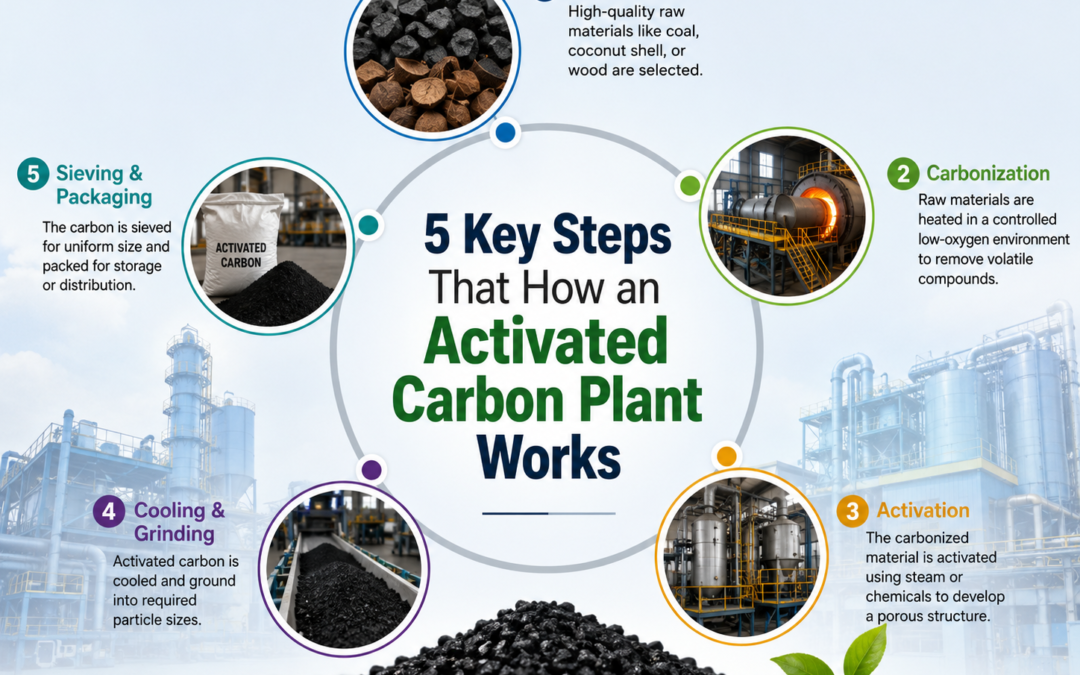
5 Key Steps That How an Activated Carbon Plant Works
5 Key Steps That How an Activated Carbon Plant Works explain the complete journey of raw carbon-rich materials into high-quality activated carbon. Activated carbon is widely used in water purification, wastewater treatment, air and gas purification, chemical processing, food and beverage industries, pharmaceuticals, and many other applications. The quality of the final product depends on proper raw material preparation, controlled carbonization, activation, cooling, screening, and packaging.
At Technomart India, we understand that a reliable activated carbon manufacturing process requires the right machinery, accurate temperature control, efficient material handling, and proper process management. A well-designed plant can help manufacturers produce activated carbon with consistent quality, suitable adsorption capacity, and better operational efficiency.
In this blog, we will explain the 5 Key Steps That How an Activated Carbon Plant Works in simple language so that manufacturers, investors, and businesses can understand the basic working process.
What Is an Activated Carbon Plant?
Before understanding the 5 Key Steps That How an Activated Carbon Plant Works, it is important to know what an activated carbon plant actually does.
An activated carbon plant is an industrial setup used to manufacture activated carbon from carbon-rich raw materials. Depending on the desired product and application, raw materials can include coconut shells, wood, coal, and other suitable carbonaceous materials.
The manufacturing process generally involves preparing the raw material, converting it into char through carbonization, activating the char to develop pores, cooling and processing the activated material, and finally screening and packing the finished product.
The main purpose of activation is to create a highly porous structure. These pores provide a large internal surface area that allows activated carbon to adsorb unwanted substances from liquids and gases.
Understanding the 5 Key Steps That How an Activated Carbon Plant Works can help businesses select suitable equipment and understand how different stages of production are connected.
Why Is Activated Carbon Important?
Activated carbon is known for its strong adsorption properties. Its porous structure allows it to capture many unwanted contaminants, impurities, colors, odors, and organic compounds.
It is commonly used in:
- Drinking water purification
- Industrial wastewater treatment
- Air purification
- Gas treatment
- Solvent recovery
- Gold recovery
- Food and beverage processing
- Pharmaceutical applications
- Chemical industries
- Industrial filtration
Because different applications require different characteristics, activated carbon may be manufactured in different forms, including powdered activated carbon, granular activated carbon, and pelletized activated carbon.
The 5 Key Steps That How an Activated Carbon Plant Works help manufacturers understand how the production process can be controlled to achieve the required product characteristics.
5 Key Steps That How an Activated Carbon Plant Works
Now, let us understand the 5 Key Steps That How an Activated Carbon Plant Works in detail.
Step 1: Raw Material Preparation
The first step in the 5 Key Steps That How an Activated Carbon Plant Works is raw material preparation.
The quality of the raw material plays an important role in determining the quality of the final activated carbon. Common raw materials include coconut shells, coal, wood, and other carbon-rich materials.
Before entering the main production equipment, the raw material needs to be prepared properly. Depending on the type of material, preparation may include cleaning, drying, crushing, and size reduction.
Cleaning
Raw materials may contain dust, stones, soil, metal pieces, or other unwanted materials. Removing these contaminants helps protect the machinery and supports smoother processing.
Drying
Moisture can affect the efficiency of the carbonization and activation stages. Therefore, suitable drying equipment may be used to reduce moisture before further processing.
Crushing and Size Reduction
Large pieces of raw material may need to be crushed into smaller and more manageable sizes. Proper particle size helps achieve more consistent heating during the next stages.
Raw material preparation is therefore an important part of the 5 Key Steps That How an Activated Carbon Plant Works because the condition of the feed material directly affects the production process.
At Technomart India, plant design can be planned according to the raw material, required capacity, and desired activated carbon characteristics.
Step 2: Carbonization
The second step in the 5 Key Steps That How an Activated Carbon Plant Works is carbonization.
Carbonization is the process of heating the prepared raw material under controlled conditions to remove volatile components and produce carbon-rich char.
During this stage, the raw material undergoes thermal decomposition. Moisture and volatile substances are released, while a carbon-rich solid material remains.
The carbonization process needs proper control of operating conditions. Factors such as temperature, heating rate, residence time, and material characteristics can influence the resulting char.
The objective is to produce a suitable char that can be effectively activated during the next stage.
Why Is Carbonization Important?
Carbonization prepares the raw material for activation. Without proper carbonization, achieving the desired pore structure and adsorption performance can become difficult.
A properly designed carbonization system can provide:
- Controlled heating
- Consistent processing
- Better heat utilization
- Reduced material losses
- Improved char quality
- Continuous production capability
For this reason, carbonization is one of the most important stages among the 5 Key Steps That How an Activated Carbon Plant Works.
Step 3: Activation
Activation is the third and one of the most important stages in the 5 Key Steps That How an Activated Carbon Plant Works.
During activation, carbonized material is treated under controlled conditions to develop its porous structure. These pores increase the internal surface area of the carbon and improve its ability to adsorb different substances.
There are different activation methods used in the activated carbon industry. Two common approaches are physical activation and chemical activation.
Physical Activation
Physical activation generally uses gases such as steam or carbon dioxide under controlled high-temperature conditions. The activating gas reacts with the carbon structure and helps develop pores.
Chemical Activation
Chemical activation uses suitable chemical agents to help develop the porous structure. The exact process depends on the raw material, chemical used, product specifications, and manufacturing requirements.
The activation conditions have a major impact on the properties of the final activated carbon. Excessive activation can reduce product yield, while insufficient activation may result in inadequate adsorption properties.
Therefore, temperature control, residence time, gas flow, and other operating parameters must be carefully managed.
The activation stage makes the 5 Key Steps That How an Activated Carbon Plant Works especially important because it is where the carbon develops the properties required for many purification and filtration applications.
Step 4: Cooling, Processing, and Screening
The fourth step in the 5 Key Steps That How an Activated Carbon Plant Works involves cooling and further processing of the activated carbon.
After activation, the material needs to be cooled under suitable conditions before further handling. Proper cooling helps protect the product and supports safer material handling.
Once cooled, the activated carbon may undergo additional processing depending on the required product form.
Crushing
If the activated carbon needs to be converted into smaller particles, crushing equipment can be used.
Grinding
Grinding may be required when a finer particle size is needed, particularly for powdered activated carbon applications.
Screening
Screening separates the material according to particle size. Different customers and applications may require specific particle-size ranges.
A screening system can help separate oversized and undersized particles and produce a more uniform final product.
Dust Management
Activated carbon processing can generate dust. Suitable dust collection and filtration systems can help maintain a cleaner working environment and reduce material losses.
Efficient cooling and processing are essential components of the 5 Key Steps That How an Activated Carbon Plant Works, especially when the plant is designed for continuous industrial production.
Step 5: Quality Testing, Storage, and Packaging
The fifth step in the 5 Key Steps That How an Activated Carbon Plant Works is quality testing, storage, and packaging.
After the activated carbon has been processed and screened, the finished material can be tested according to the required specifications.
Quality testing may include parameters such as:
- Moisture content
- Ash content
- Particle size
- Iodine number
- Adsorption performance
- Hardness
- Bulk density
The exact tests depend on the type of activated carbon and its intended application.
After quality approval, the product can be stored in suitable conditions before packaging and dispatch.
Packaging is important because it protects activated carbon from contamination, moisture, and handling-related issues.
Activated carbon may be packed in different types and sizes of bags depending on customer requirements, transportation conditions, and application.
This completes the 5 Key Steps That How an Activated Carbon Plant Works, taking the material from raw feedstock to a finished product ready for industrial use.
How Different Machines Work Together
The 5 Key Steps That How an Activated Carbon Plant Works are not independent operations. Each stage is connected with the next stage through material handling and process-control systems.
A typical plant may include equipment such as:
- Raw material handling systems
- Crushers
- Dryers
- Carbonization equipment
- Activation furnace
- Cooling systems
- Pulverizers or grinders
- Vibrating screens
- Dust collection systems
- Conveyors
- Storage systems
- Packing equipment
The exact machinery configuration depends on factors such as raw material, production capacity, activation method, product specifications, plant layout, and customer requirements.
A properly integrated system helps reduce unnecessary manual handling and supports smooth material movement throughout the plant.
Importance of Temperature Control
Temperature control is a major factor throughout the 5 Key Steps That How an Activated Carbon Plant Works.
Carbonization and activation require controlled thermal conditions. If temperatures are too low, the desired transformation may not occur properly. If temperatures are too high or the material is exposed for too long, product yield and quality may be affected.
Modern industrial plants can incorporate temperature monitoring and control systems to help operators maintain suitable process conditions.
Consistent temperature management can contribute to more uniform production and better control over product characteristics.
Importance of Automation
Automation can make the 5 Key Steps That How an Activated Carbon Plant Works more efficient and manageable.
Depending on the plant design, automation can help monitor:
- Temperature
- Material feeding
- Gas flow
- Residence time
- Conveyor operation
- Furnace operation
- Cooling
- Dust collection
- Production parameters
Automation can reduce manual intervention and help operators identify process variations more quickly.
For larger production facilities, centralized monitoring and control can provide better visibility of plant operations.
Benefits of a Properly Designed Activated Carbon Plant
Understanding the 5 Key Steps That How an Activated Carbon Plant Works also helps explain why plant design is important.
A properly designed plant can provide several benefits.
1. Consistent Production
Controlled processing can help manufacturers maintain more consistent product quality from batch to batch or throughout continuous production.
2. Better Resource Utilization
Efficient equipment and heat management can help improve the utilization of raw materials and energy.
3. Improved Productivity
A well-integrated plant can support higher production capacity while reducing unnecessary material handling.
4. Better Product Control
Screening, processing, and quality testing help manufacturers produce activated carbon according to required specifications.
5. Industrial Scalability
A properly planned plant can be designed around present requirements while allowing businesses to consider future capacity expansion.
These advantages make it important to understand the 5 Key Steps That How an Activated Carbon Plant Works before investing in a production facility.
Role of Technomart India in Activated Carbon Plant Solutions
Technomart India provides industrial plant and machinery solutions for businesses involved in activated carbon manufacturing.
When planning an activated carbon plant, several factors need to be considered, including raw material selection, production capacity, process configuration, equipment selection, plant layout, energy requirements, and desired product characteristics.
The 5 Key Steps That How an Activated Carbon Plant Works provide a basic framework for understanding these requirements.
Technomart India focuses on developing plant solutions according to specific production needs rather than relying on a single configuration for every customer.
From raw material handling and processing to carbonization, activation, cooling, screening, and final handling, every stage needs to work together for efficient plant operation.
How to Choose the Right Activated Carbon Plant
Before selecting an activated carbon plant, businesses should consider several important points.
First, determine the type of raw material that will be used. Coconut shell, coal, wood, and other materials can have different processing requirements.
Second, identify the required production capacity. A small-scale operation and a large industrial facility may require completely different equipment configurations.
Third, determine the desired final product. Powdered, granular, and pelletized activated carbon can require different processing and sizing systems.
Fourth, consider the required quality parameters and applications. Water treatment, air purification, chemical processing, and other industries may have different product requirements.
Finally, select a plant manufacturer with suitable technical knowledge and experience.
Understanding the 5 Key Steps That How an Activated Carbon Plant Works can help businesses ask the right questions before purchasing equipment.
Conclusion
The 5 Key Steps That How an Activated Carbon Plant Works provide a simple way to understand the complete activated carbon manufacturing process. The journey starts with raw material preparation, followed by carbonization, activation, cooling and processing, and finally quality testing, storage, and packaging.
Each stage has an important role in determining the quality, consistency, and efficiency of the final activated carbon product. Proper equipment selection, temperature control, material handling, process monitoring, and quality testing can make a significant difference in plant performance.
For businesses planning to enter or expand in the activated carbon industry, understanding the 5 Key Steps That How an Activated Carbon Plant Works is an important starting point.
Technomart India can help businesses understand their plant requirements and develop suitable machinery solutions based on raw material, production capacity, product specifications, and application requirements.
Whether the objective is water treatment, wastewater purification, air filtration, gas treatment, or industrial adsorption, a well-planned activated carbon plant can provide a strong foundation for reliable and efficient production.
By focusing on the 5 Key Steps That How an Activated Carbon Plant Works, manufacturers can better understand the relationship between raw materials, thermal processing, activation, product finishing, and final quality. This knowledge can help businesses make more informed decisions when planning their activated carbon manufacturing facility.
To learn more about the Activated Carbon Plant Manufacturer, explore our related blogs:
-
Best Activated Carbon Manufacturer in India: Read More