
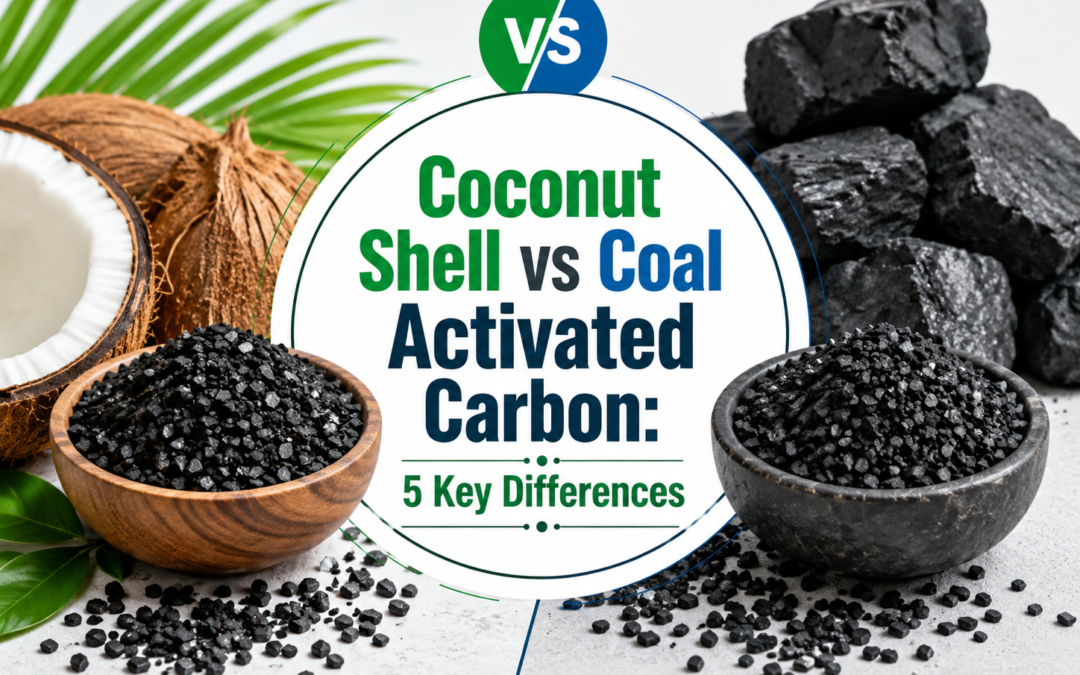
Coconut Shell vs Coal Activated Carbon: 5 Key Differences
Coconut Shell vs Coal Activated Carbon: 5 Key Differences is an important comparison for industries that need effective adsorption, purification, and filtration solutions. Activated carbon is widely used for removing impurities, odors, colors, organic compounds, and other contaminants from air, water, chemicals, and industrial streams. Although both coconut shell and coal-based activated carbon offer strong adsorption performance, they differ in pore structure, applications, raw materials, regeneration characteristics, and environmental considerations. Understanding these differences can help businesses select the right activated carbon for their specific process requirements.
Activated carbon is a highly porous material produced by processing carbon-rich raw materials through controlled carbonization and activation. The quality and characteristics of the final product depend significantly on the raw material used and the manufacturing process. Coconut shells and coal are two commonly used feedstocks for producing activated carbon, and each produces a carbon material with distinct properties.
For industries evaluating different grades of activated carbon, Coconut Shell vs Coal Activated Carbon: 5 Key Differences provides a useful framework for making an informed choice. Technomart India understands the importance of selecting the right activated carbon production technology and equipment based on desired product characteristics, capacity, and application requirements.
What Is Activated Carbon?
Before understanding Coconut Shell vs Coal Activated Carbon: 5 Key Differences, it is important to understand activated carbon itself. Activated carbon is a carbonaceous material with a highly developed pore structure and large internal surface area. This structure allows it to adsorb various substances from gases and liquids.
Activated carbon is used in several industries, including:
- Drinking water purification
- Industrial wastewater treatment
- Air and gas purification
- Food and beverage processing
- Pharmaceutical manufacturing
- Chemical processing
- Solvent recovery
- Gold recovery
- Deodorization
- Industrial pollution control
Activated carbon can be manufactured from different raw materials, including coconut shells, coal, wood, and other carbon-rich materials. The choice of raw material influences the pore distribution, hardness, ash content, and adsorption characteristics of the finished carbon.
Therefore, Coconut Shell vs Coal Activated Carbon: 5 Key Differences is not simply a comparison of two products; it is a comparison of two different approaches to producing an adsorption material for different industrial requirements.
1. Raw Material and Source
The first important point in Coconut Shell vs Coal Activated Carbon: 5 Key Differences is the raw material used for manufacturing.
Coconut shell activated carbon is made from coconut shells, an agricultural by-product. Coconut shells contain a high proportion of carbon and can be processed into high-quality activated carbon. Since coconut shells are renewable biomass, they are commonly considered an attractive raw material for applications where renewable feedstocks are preferred.
Coal-based activated carbon, on the other hand, is manufactured from different grades of coal. Coal is a naturally occurring fossil resource with characteristics that vary depending on its type and origin. Different coal grades can produce activated carbon with different pore structures and adsorption properties.
This difference in feedstock has a direct impact on the characteristics of the final product.
In Coconut Shell vs Coal Activated Carbon: 5 Key Differences, raw material availability and suitability should therefore be considered according to the intended application. Manufacturers must evaluate feedstock quality, processing requirements, availability, and desired carbon characteristics before selecting a production route.
For activated carbon plant manufacturers and project developers, raw material selection is also an important factor when designing the carbonization and activation system.
2. Pore Structure and Adsorption Performance
The second major point in Coconut Shell vs Coal Activated Carbon: 5 Key Differences is pore structure.
Activated carbon contains millions of microscopic pores. These pores provide the internal surface area required for adsorption. However, not all activated carbon has the same pore distribution.
Coconut shell activated carbon generally develops a predominantly microporous structure. Micropores are particularly useful for adsorbing smaller molecules. Because of this characteristic, coconut shell carbon is commonly used in applications such as drinking water treatment, air purification, and certain gas-phase adsorption processes.
Coal-based activated carbon generally offers a broader pore-size distribution, including a greater proportion of mesopores depending on the coal grade and activation conditions. This can make coal-based carbon suitable for applications involving larger organic molecules.
However, it is important to remember that activation conditions can significantly influence pore development. Temperature, activation time, activating agent, and process design all contribute to the final pore structure.
Thus, Coconut Shell vs Coal Activated Carbon: 5 Key Differences should be evaluated based on the actual adsorption requirement rather than simply assuming that one material is universally better.
3. Hardness and Physical Properties
Another important factor in Coconut Shell vs Coal Activated Carbon: 5 Key Differences is physical strength.
Coconut shell activated carbon is generally known for good hardness and resistance to abrasion. This can be beneficial in applications where carbon particles experience movement, backwashing, transportation, or repeated handling.
Lower abrasion can help reduce carbon losses and minimize the generation of fine particles during certain operating conditions.
Coal-based activated carbon can also provide good mechanical strength, although its physical characteristics depend on the coal feedstock and manufacturing method.
Physical properties can become especially important in fixed-bed filtration systems. If carbon particles break down excessively, fines can affect pressure drop, filtration performance, and downstream equipment.
For this reason, buyers should evaluate parameters such as particle size, hardness, abrasion resistance, moisture, ash content, and bulk density along with adsorption capacity.
When comparing Coconut Shell vs Coal Activated Carbon: 5 Key Differences, physical strength should therefore be considered together with the operating conditions of the application.
4. Applications and Industrial Suitability
The fourth major point in Coconut Shell vs Coal Activated Carbon: 5 Key Differences is application suitability.
Coconut shell activated carbon is widely used in applications where microporous carbon is advantageous. Common applications include:
- Drinking water purification
- Point-of-use water filtration
- Air purification
- Gas purification
- Odor removal
- Food and beverage applications
- Certain pharmaceutical processes
- Gold recovery applications
Coal-based activated carbon is commonly used in broader industrial applications where a combination of micropores and mesopores is beneficial. Depending on its specifications, it may be used for:
- Municipal water treatment
- Industrial wastewater treatment
- Chemical purification
- Industrial gas treatment
- Decolorization
- Solvent recovery
- Flue gas treatment
- General industrial purification
The actual application depends on the carbon grade and required performance. Different industries require different iodine numbers, methylene blue values, molasses numbers, surface areas, ash levels, particle sizes, and other specifications.
Therefore, Coconut Shell vs Coal Activated Carbon: 5 Key Differences should always be considered in relation to the target application.
For example, a carbon selected for drinking water treatment may have very different specifications from carbon intended for industrial wastewater or gas purification.
5. Sustainability and Environmental Considerations
The fifth point in Coconut Shell vs Coal Activated Carbon: 5 Key Differences is sustainability.
Coconut shells are agricultural residues generated during coconut processing. Using these shells as a feedstock can create value from an existing biomass resource and reduce dependence on fossil-based raw materials.
This makes coconut shell activated carbon attractive for businesses that prioritize renewable raw materials and sustainability objectives.
Coal, meanwhile, is a fossil resource. Coal-based activated carbon can offer excellent adsorption performance and remains widely used for many industrial applications, but its raw material source carries different environmental considerations.
The overall environmental impact of activated carbon production depends on much more than the raw material alone. Energy consumption, activation technology, emissions control, process efficiency, transportation, product lifetime, and regeneration practices can all influence sustainability.
Consequently, Coconut Shell vs Coal Activated Carbon: 5 Key Differences should be viewed from a complete lifecycle perspective rather than focusing on only one environmental factor.
Coconut Shell vs Coal Activated Carbon: Which One Is Better?
After understanding Coconut Shell vs Coal Activated Carbon: 5 Key Differences, the next question is which type is better.
There is no universal answer.
The better option depends on the specific application and required performance.
Coconut shell activated carbon may be a suitable choice when:
- High microporosity is required.
- Small molecules need to be adsorbed.
- High hardness is important.
- Renewable raw material is preferred.
- Water or gas purification is the primary application.
Coal-based activated carbon may be preferable when:
- A broader pore distribution is required.
- Larger molecules need to be adsorbed.
- Industrial-scale treatment is required.
- A particular coal-based carbon specification matches the process.
- The application requires specific adsorption characteristics.
Therefore, Coconut Shell vs Coal Activated Carbon: 5 Key Differences should help buyers understand that product selection should be based on technical requirements rather than choosing one material simply because it is considered better.
Role of Activation Technology
The quality of activated carbon does not depend only on its raw material. The activation process plays a critical role.
Activated carbon can generally be produced through physical or chemical activation. Physical activation commonly involves carbonization followed by activation using steam or carbon dioxide under controlled conditions.
The process must be carefully controlled to achieve the required pore structure and adsorption properties.
Important production parameters can include:
- Carbonization temperature
- Activation temperature
- Residence time
- Steam flow
- Air or gas control
- Feedstock size
- Heating rate
- Cooling conditions
- Product screening
- Quality testing
For this reason, Coconut Shell vs Coal Activated Carbon: 5 Key Differences should also be understood from a manufacturing perspective. Two activated carbons made from the same raw material can have different properties if their manufacturing processes are different.
Technomart India focuses on providing industrial plant and machinery solutions designed around the customer’s production requirements. A properly planned activated carbon production system can help manufacturers maintain consistent processing conditions and produce carbon according to targeted specifications.
Why Quality Control Matters
Quality control is another important consideration when discussing Coconut Shell vs Coal Activated Carbon: 5 Key Differences.
A reliable activated carbon manufacturing process should include appropriate testing and monitoring. Depending on the intended application, manufacturers may evaluate:
- Iodine number
- Methylene blue adsorption
- Moisture content
- Ash content
- Bulk density
- Hardness
- Particle size
- Surface area
- Pore volume
- pH
- Adsorption capacity
These parameters help determine whether the finished product meets the required specifications.
For industrial buyers, simply knowing whether carbon is coconut-shell-based or coal-based is not enough. They should also evaluate the technical data sheet and application-specific performance.
Why Choose the Right Activated Carbon Plant?
The discussion of Coconut Shell vs Coal Activated Carbon: 5 Key Differences is also relevant for entrepreneurs planning to establish an activated carbon manufacturing facility.
A plant must be designed according to the selected feedstock and expected production capacity. Equipment selection can influence energy consumption, production consistency, product quality, and operational efficiency.
An activated carbon plant may include equipment and systems for:
- Raw material preparation
- Carbonization
- Activation
- Cooling
- Crushing
- Screening
- Grinding
- Classification
- Storage
- Packaging
The exact configuration depends on the manufacturing process and product specifications.
Technomart India can support businesses looking for industrial machinery and plant solutions by understanding their production objectives and designing equipment configurations around their requirements.
Coconut Shell vs Coal Activated Carbon: 5 Key Differences at a Glance
The comparison can be summarized as follows:
| Factor | Coconut Shell Activated Carbon | Coal-Based Activated Carbon |
|---|---|---|
| Raw Material | Coconut shell biomass | Coal |
| Typical Pore Structure | More microporous | Broader pore distribution |
| Common Applications | Water, air, and gas purification | Water, wastewater and industrial treatment |
| Hardness | Generally high | Depends on coal grade and processing |
| Sustainability | Renewable agricultural residue | Fossil-based raw material |
| Best Selection Method | Based on application requirements | Based on application requirements |
This table demonstrates why Coconut Shell vs Coal Activated Carbon: 5 Key Differences is useful when comparing activated carbon options for different industries.
How to Select the Right Activated Carbon
When selecting activated carbon, businesses should consider more than raw material.
First, identify the contaminant that needs to be removed. The molecular size and chemical properties of the contaminant can influence the required pore structure.
Second, determine whether the process involves liquid-phase or gas-phase adsorption.
Third, evaluate the required adsorption capacity and physical properties.
Fourth, consider operating conditions such as temperature, pH, flow rate, contact time, and pressure.
Finally, compare the total operating cost, availability, product quality, regeneration possibilities, and environmental considerations.
By following these steps, companies can make a more informed decision based on actual process requirements.
Conclusion
Coconut Shell vs Coal Activated Carbon: 5 Key Differences provides a practical way to understand how two major activated carbon feedstocks differ in raw material, pore structure, physical properties, applications, and sustainability.
Coconut shell activated carbon can be an excellent choice for applications requiring strong microporosity, good hardness, and renewable biomass-based feedstock. Coal-based activated carbon can be highly suitable for applications where a broader pore structure and specific industrial adsorption characteristics are required.
Neither option is automatically the best for every application. The right choice depends on the contaminant, process conditions, adsorption requirements, product specifications, and overall project objectives.
For businesses planning to manufacture activated carbon, selecting the appropriate production technology is equally important. Proper carbonization, activation, cooling, crushing, screening, and quality-control systems can contribute to consistent product quality and efficient operation.
At Technomart India, we understand that every activated carbon manufacturing project can have different requirements. From plant planning and machinery selection to production capacity and process configuration, the right industrial solution can help manufacturers build an efficient and reliable production setup.
Ultimately, Coconut Shell vs Coal Activated Carbon: 5 Key Differences should not be viewed as a competition between two materials. Instead, it should be used as a guide for identifying which activated carbon type is most appropriate for a particular industrial application. By evaluating technical performance, raw material availability, sustainability, and manufacturing requirements, businesses can select a solution that supports long-term productivity and product quality.
Coconut Shell vs Coal Activated Carbon: 5 Key Differences is therefore an essential consideration for anyone involved in activated carbon purchasing, production, plant planning, or industrial filtration. With the right technical evaluation and suitable manufacturing technology, both types of activated carbon can provide valuable adsorption performance across a wide range of applications.
To learn more about the Activated Carbon Plant Manufacturer, explore our related blogs:
-
Best Activated Carbon Manufacturer in India: Read More