
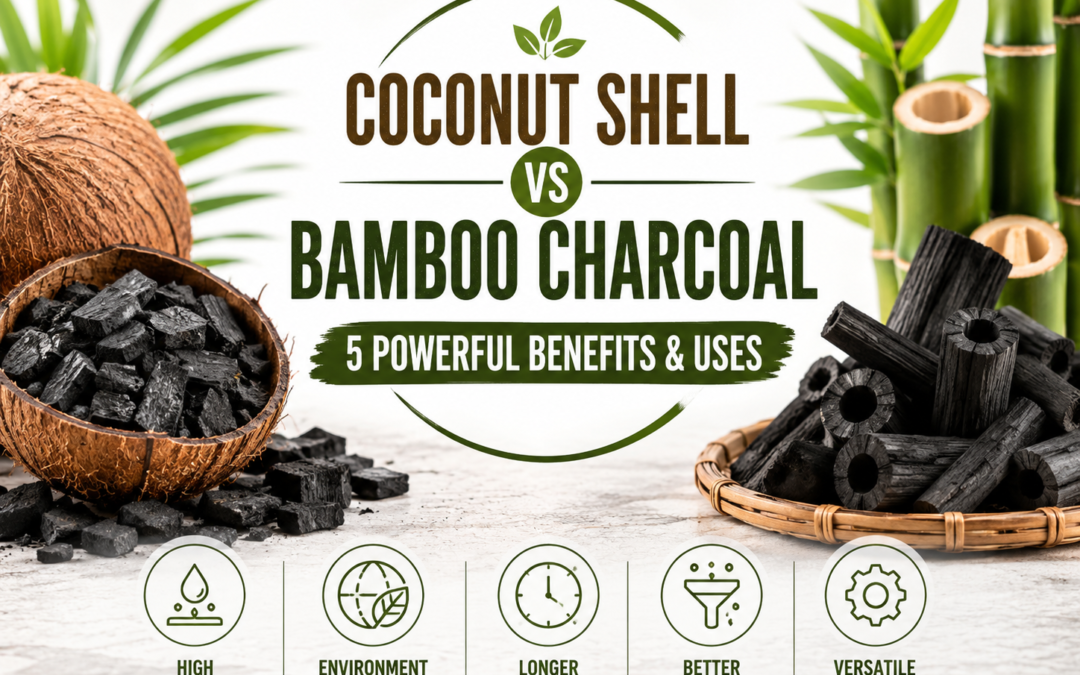
Coconut Shell vs Bamboo Charcoal: 5 Powerful Benefits & Uses
Coconut Shell vs Bamboo Charcoal: 5 Powerful Benefits & Uses is an important comparison for industries and businesses looking for an effective carbon-based material for purification, filtration, adsorption, and other applications. Although both coconut shell charcoal and bamboo charcoal are made from natural biomass, their properties, pore structures, performance, and applications can differ significantly. Understanding these differences can help manufacturers, water treatment companies, industries, and buyers select the right material for their specific requirements.
Charcoal has been used for centuries because of its ability to adsorb unwanted substances. Today, advanced processing techniques have made charcoal an important raw material for producing activated carbon. Coconut shells and bamboo are two popular biomass sources used for this purpose. However, choosing between them requires an understanding of their characteristics and intended applications.
At Technomart India, we understand the importance of selecting the right activated carbon production technology according to raw material, capacity, and application. As an experienced manufacturer and supplier of activated carbon plant solutions in India, we help industries understand the production process and select suitable equipment for efficient charcoal and activated carbon production.
What Is Coconut Shell Charcoal?
Coconut shell charcoal is produced by carbonizing coconut shells under controlled conditions with limited oxygen. Coconut shells are an agricultural by-product and can be converted into a valuable carbon-rich material instead of being discarded as waste.
After carbonization, coconut shell charcoal can be further processed to produce activated carbon. Activation increases its internal pore structure and adsorption capacity. Steam activation and chemical activation are commonly used methods depending on the desired characteristics of the final product.
One of the major advantages of coconut shell-based activated carbon is its microporous structure. This makes it particularly useful for applications where the adsorption of smaller molecules is important.
When discussing Coconut Shell vs Bamboo Charcoal: 5 Powerful Benefits & Uses, coconut shell charcoal is often preferred for applications requiring high microporosity and good adsorption performance.
What Is Bamboo Charcoal?
Bamboo charcoal is produced by heating bamboo under controlled conditions in an oxygen-limited environment. Bamboo grows relatively quickly and can provide a renewable biomass source for charcoal production.
Bamboo charcoal is known for its porous structure and can be processed further to produce activated carbon. Depending on the manufacturing and activation process, bamboo-based activated carbon can have different pore structures and adsorption characteristics.
Bamboo charcoal is used in various applications, including air purification, water treatment, odor control, moisture management, and certain industrial processes.
The comparison of Coconut Shell vs Bamboo Charcoal: 5 Powerful Benefits & Uses becomes particularly useful when deciding which biomass source is better suited for a specific activated carbon production requirement.
Coconut Shell vs Bamboo Charcoal: Key Difference
The biggest difference between coconut shell charcoal and bamboo charcoal comes from their raw materials and resulting pore structures.
Coconut shell charcoal generally has a high proportion of micropores, while bamboo charcoal can offer a broader pore structure depending on the bamboo species and production conditions. These differences influence adsorption performance and determine where the resulting activated carbon is most suitable.
Another important consideration is raw material availability. Coconut shells are commonly available in coconut-producing regions, while bamboo is abundant in regions with significant bamboo cultivation.
Production temperature, carbonization conditions, activation method, residence time, and equipment design can also influence the properties of the final activated carbon.
Therefore, Coconut Shell vs Bamboo Charcoal: 5 Powerful Benefits & Uses should not be viewed simply as a competition between two materials. The better choice depends on the required application, target contaminants, desired pore structure, production economics, and availability of raw materials.
5 Powerful Benefits and Uses
1. Water Purification
One of the most important applications of activated carbon is water purification. Activated carbon can adsorb a wide range of organic compounds, taste-causing substances, odors, and other impurities.
Coconut shell-based activated carbon is widely used in water filtration because of its microporous structure and adsorption characteristics. It can be used in point-of-use filters, industrial water treatment systems, drinking water treatment, and other filtration applications.
Bamboo-based activated carbon can also be used in water treatment, depending on its activation process and final pore characteristics.
For companies evaluating Coconut Shell vs Bamboo Charcoal: 5 Powerful Benefits & Uses, water treatment is an important area where the final carbon specifications should be considered rather than selecting material based only on its raw source.
2. Air and Gas Purification
Activated carbon is also used for removing odors and certain gaseous contaminants from air streams.
Coconut shell activated carbon can be used in air purification systems, odor-control units, respirator filters, and industrial gas treatment applications. Its microporous structure can provide effective adsorption for certain low-molecular-weight compounds.
Bamboo activated carbon may also be used for odor and air purification applications when manufactured with suitable pore characteristics.
The effectiveness of either material depends on the activation process, surface area, pore volume, particle size, moisture content, and target contaminant.
This makes air purification another important consideration when studying Coconut Shell vs Bamboo Charcoal: 5 Powerful Benefits & Uses.
3. Odor Control
Unpleasant odors can occur in homes, commercial facilities, wastewater treatment plants, food-processing units, and industrial environments.
Activated carbon is commonly used for odor control because its porous structure can capture various odor-causing compounds through adsorption.
Coconut shell charcoal can be converted into high-quality activated carbon suitable for many odor-control applications. Bamboo charcoal is also commonly associated with odor absorption and can be used in selected purification products.
For industrial applications, however, the activated carbon should be selected according to the specific compounds that need to be removed.
This is why Coconut Shell vs Bamboo Charcoal: 5 Powerful Benefits & Uses is relevant for businesses looking beyond general charcoal products and considering industrial activated carbon.
4. Industrial Filtration
Activated carbon plays an important role in several industrial filtration processes. Industries may use activated carbon for wastewater treatment, process-water purification, chemical processing, food and beverage applications, and other purification requirements.
Coconut shell activated carbon is particularly popular where microporous carbon is suitable for the target application.
Bamboo-based activated carbon can also be produced for industrial use, provided that the activation process delivers the required adsorption characteristics.
When comparing Coconut Shell vs Bamboo Charcoal: 5 Powerful Benefits & Uses, industries should evaluate technical specifications such as iodine number, ash content, moisture, particle size, surface area, hardness, and pore distribution.
5. Raw Material and Sustainability Benefits
Both coconut shells and bamboo offer interesting sustainability advantages because they are biomass-based materials.
Coconut shells can be utilized as an agricultural by-product. Converting them into charcoal and activated carbon provides an additional use for a material that might otherwise have limited value.
Bamboo is also considered an attractive biomass resource because of its rapid growth and renewable nature. However, sustainability depends on how the raw material is cultivated, harvested, transported, and processed.
Therefore, the environmental advantages of both materials should be considered across the complete production cycle.
This is another reason why Coconut Shell vs Bamboo Charcoal: 5 Powerful Benefits & Uses is important for manufacturers planning a biomass-based carbon production facility.
Coconut Shell Charcoal vs Bamboo Charcoal: Which Is Better?
There is no universal answer to which charcoal is better. The correct choice depends on the application and the specifications required from the final product.
Coconut shell charcoal is often attractive when the goal is to produce activated carbon with a predominantly microporous structure. It can be particularly useful for applications involving smaller molecules and certain water and gas purification processes.
Bamboo charcoal offers flexibility as a biomass-based raw material and can be processed to create different characteristics depending on the production and activation conditions.
Therefore, the right question is not simply which charcoal is better, but which charcoal is better for a particular application.
For businesses researching Coconut Shell vs Bamboo Charcoal: 5 Powerful Benefits & Uses, this application-focused approach can result in a better investment decision.
Factors to Consider Before Choosing the Raw Material
Before setting up a charcoal or activated carbon manufacturing facility, manufacturers should consider several factors.
Raw Material Availability
The continuous availability of coconut shells or bamboo is important for maintaining consistent plant production. Transportation costs and seasonal availability should also be evaluated.
Desired Activated Carbon Quality
Different applications require different activated carbon specifications. The desired iodine number, surface area, pore volume, hardness, ash content, and particle size should be established before selecting the raw material and production process.
Activation Technology
Activation is one of the most important stages of activated carbon manufacturing. Steam activation and chemical activation can produce different characteristics.
Production Capacity
A plant designed for small-scale production will have different equipment requirements compared with a large industrial facility.
Energy Consumption
Carbonization and activation require controlled heating. Efficient furnace and activation systems can help manufacturers manage energy consumption and production costs.
Final Application
The intended application should always guide the production process. Water purification, air filtration, wastewater treatment, gas purification, and industrial processing may require different grades of activated carbon.
These considerations are essential when evaluating Coconut Shell vs Bamboo Charcoal: 5 Powerful Benefits & Uses from a commercial and manufacturing perspective.
How Activated Carbon Is Produced From Coconut Shells and Bamboo
The manufacturing process generally starts with raw material preparation. Coconut shells or bamboo are cleaned and prepared before carbonization.
During carbonization, the biomass is heated under controlled oxygen conditions. This removes volatile components and produces carbon-rich charcoal.
The charcoal is then crushed or sized according to the production requirements. After that, the activation process develops additional pores within the carbon structure.
In steam activation, controlled steam is introduced at elevated temperatures. The steam reacts with carbon and creates additional pores.
Following activation, the material can be cooled, screened, crushed, pulverized, or pelletized depending on the required product specification.
Quality testing is then carried out to ensure that the activated carbon meets the desired specifications.
At Technomart India, activated carbon plant design can be planned according to the selected raw material, production capacity, activation technology, and final product requirements.
Why Choose Technomart India for Activated Carbon Plant Solutions?
Technomart India focuses on providing industrial plant and machinery solutions for activated carbon production. Choosing the right equipment is important because the quality of activated carbon depends not only on the raw material but also on carbonization, activation, temperature control, residence time, and material handling.
A properly designed activated carbon plant can help manufacturers achieve consistent production while improving process efficiency.
Technomart India can support businesses looking to establish activated carbon manufacturing facilities with equipment and plant solutions designed around their specific production requirements.
For businesses studying Coconut Shell vs Bamboo Charcoal: 5 Powerful Benefits & Uses, selecting the appropriate plant technology is as important as selecting the raw material itself.
Final Thoughts
Coconut Shell vs Bamboo Charcoal: 5 Powerful Benefits & Uses highlights how two natural biomass materials can be converted into valuable carbon products with different characteristics and applications.
Coconut shell charcoal is particularly attractive for producing microporous activated carbon and is widely considered for water, air, gas, and industrial filtration applications. Bamboo charcoal is another renewable biomass option that can be processed into activated carbon for purification and adsorption applications.
The final performance depends on much more than the original raw material. Carbonization conditions, activation technology, temperature, activation time, pore structure, surface area, particle size, and quality control all have an impact on the final product.
For manufacturers planning to enter the activated carbon industry, a detailed assessment of raw material availability, production capacity, target market, product specifications, energy requirements, and plant design is essential.
Technomart India helps businesses explore suitable activated carbon plant manufacturing and setup solutions according to their production goals. With the right raw material, appropriate processing technology, and properly designed equipment, coconut shells and bamboo can become valuable feedstocks for producing high-quality activated carbon.
Ultimately, Coconut Shell vs Bamboo Charcoal: 5 Powerful Benefits & Uses is not about declaring one material universally superior. It is about understanding the differences and selecting the material and manufacturing process that best matches the intended application.
To learn more about the Activated Carbon Plant Manufacturer, explore our related blogs:
-
Best Activated Carbon Manufacturer in India: Read More