
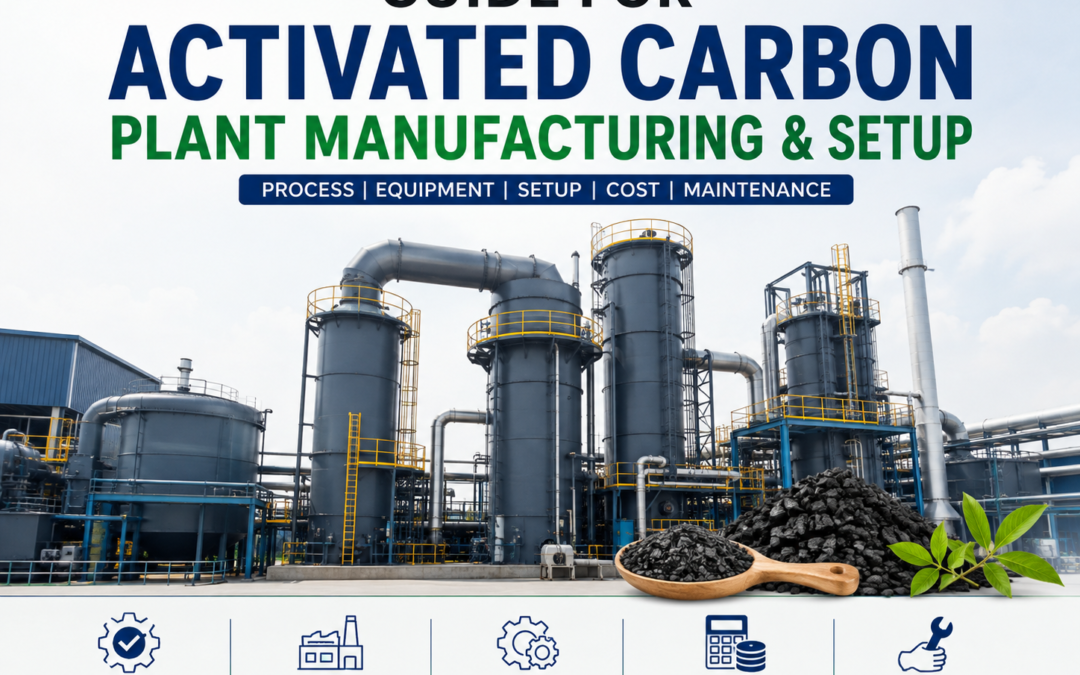
Guide For Activated Carbon Plant Manufacturing & Setup
Guide For Activated Carbon Plant Manufacturing & Setup. Setting up an activated carbon manufacturing facility requires careful planning, suitable machinery, reliable raw materials, efficient process control, and a clear understanding of the final product requirements. This Guide For Activated Carbon Plant Manufacturing & Setup explains the major stages involved in establishing a production facility and the important factors manufacturers should consider before starting the project.
Technomart India is an experienced engineering company specializing in the design, manufacturing, installation, and commissioning of industrial plants. As an Activated Carbon Plant Manufacturer in India, Technomart India provides customized plant solutions for different raw materials, production capacities, and applications.
What Is an Activated Carbon Plant?
An activated carbon plant is an industrial production system used to convert carbon-rich raw materials into activated carbon with a developed pore structure and strong adsorption properties. Depending on the required product, manufacturers can use materials such as coconut shells, wood, coal, bamboo, and other suitable carbonaceous materials.
The Guide For Activated Carbon Plant Manufacturing & Setup begins with understanding the complete production cycle. In a typical plant, raw material preparation is followed by carbonization, activation, cooling, grinding or screening, quality control, and packaging.
The exact process configuration depends on the raw material, desired grade, production capacity, and application of the final activated carbon.
Why Is Proper Plant Planning Important?
Before purchasing machinery, it is important to define the production objective. A plant designed for granular activated carbon may have different requirements from one designed primarily for powdered or specialty grades.
A proper Guide For Activated Carbon Plant Manufacturing & Setup should therefore begin with:
- Required production capacity
- Raw material availability
- Desired activated carbon grade
- Required particle size
- Activation method
- Fuel and power availability
- Land and plant layout
- Pollution-control requirements
- Storage and packaging requirements
- Quality-testing facilities
- Target market and applications
Technomart India develops plant solutions according to the customer’s production requirements rather than relying on a single standard configuration. Its activated carbon solutions can be designed around different raw materials and industrial applications.
Selection of Raw Materials
Raw material selection has a direct effect on the production process and the characteristics of the final product.
Common raw materials include:
- Coconut shell
- Wood
- Coal
- Bamboo
- Agricultural residues
- Other carbonaceous biomass
Coconut shell is widely used for producing certain high-quality activated carbon grades, while coal and wood can also be used depending on the required application and product characteristics.
For this reason, the Guide For Activated Carbon Plant Manufacturing & Setup should always include a raw-material evaluation before equipment selection.
The raw material should be assessed for moisture, ash content, volatile matter, particle size, availability, and consistency. Stable raw material supply can help maintain consistent plant operation and product quality.
Main Stages of Activated Carbon Manufacturing
The Guide For Activated Carbon Plant Manufacturing & Setup can be broadly divided into several important stages.
1. Raw Material Preparation
The first stage is preparing the raw material for further processing.
Depending on the material, this may involve:
- Crushing
- Screening
- Destoning
- Removal of impurities
- Size classification
- Drying
- Material conveying
Proper sizing helps create more uniform processing conditions inside the carbonization and activation equipment.
Technomart‘s plant solutions include raw material handling equipment, storage systems, crushers, grinders, screens, and conveying arrangements as required by the project.
2. Carbonization
Carbonization converts the prepared raw material into carbon-rich char or charcoal by controlled heating under limited-oxygen conditions.
This stage is an important part of the Guide For Activated Carbon Plant Manufacturing & Setup because the quality of the char directly influences the subsequent activation process.
Rotary kilns and other furnace configurations can be used for carbonization depending on the plant design. Technical references describe rotary kiln processes in which carbonaceous material is progressively heated and carbonized before entering the activation zone.
Temperature, residence time, feed size, and airflow must be controlled carefully to achieve consistent carbonization.
3. Activation
Activation is the stage that develops the pore structure responsible for activated carbon’s adsorption performance.
Physical activation commonly uses steam or gases at high temperatures. Chemical activation uses activating chemicals and generally involves additional washing and recovery steps.
Steam activation is commonly incorporated into continuous industrial systems. Depending on the technology and raw material, activation temperatures can be in the high-temperature range, often around 800–1000°C or higher.
Technomart India designs activated carbon plant systems with process control considerations such as temperature, material movement, activation conditions, and residence time.
4. Cooling
Activated carbon should be cooled properly after activation before further processing and storage.
Cooling equipment helps reduce the temperature of the activated material and supports safer downstream handling. Technomart’s published plant information includes cooling systems designed to reduce the risk of auto-ignition during activated carbon handling.
Cooling is therefore an important section of any Guide for Activated Carbon Plant Manufacturing & Setup.
5. Grinding and Screening
After cooling, the material can be processed according to the required product specification.
Depending on the final product, the plant may use:
- Hammer mills
- Pulverizers
- Crushers
- Vibrating screens
- Grading systems
- Magnetic separators
Screening helps separate activated carbon according to particle size, while grinding can be used when finer material is required.
Activated carbon can be supplied in different forms, including granular and powdered grades, depending on the intended application.
6. Washing and Purification
Some activated carbon products require additional washing or purification.
Washing may help remove soluble impurities, ash, residual chemicals, or other unwanted materials depending on the manufacturing route and final specification.
Chemical activation processes can require washing and recovery stages after activation.
Therefore, a complete Guide For Activated Carbon Plant Manufacturing & Setup should consider whether washing, neutralization, drying, or effluent-treatment facilities are required for the selected process.
7. Drying
After washing, the activated carbon may contain excess moisture and therefore require drying.
Rotary dryers or fluid-bed dryers can be incorporated depending on the plant configuration. Technomart’s published plant specifications include drying systems designed to reduce product moisture before final handling.
8. Packaging and Storage
The final stage involves grading, weighing, packing, and storing the finished activated carbon.
Packaging requirements depend on:
- Product grade
- Particle size
- Customer requirements
- Domestic or export market
- Transportation method
Suitable storage conditions are also important because activated carbon needs to be protected from contamination and unwanted moisture during handling.
Machinery Required for an Activated Carbon Plant
One of the most important sections of the Guide For Activated Carbon Plant Manufacturing & Setup is understanding the major machinery required.
A typical plant may include:
- Raw material hopper
- Crusher or grinder
- Conveyor system
- Dryer
- Carbonization kiln or furnace
- Activated carbon rotary kiln or activation furnace
- Steam generation system
- Cooling system
- Pulverizer or hammer mill
- Vibrating screen
- Magnetic separator
- Washing system, if required
- Drying system
- Storage silos or hoppers
- Bagging and packaging equipment
- Pollution-control equipment
- Electrical and control panels
The exact machinery list should be finalized after evaluating the raw material, capacity, activation method, product specification, and plant layout.
Choosing the Right Activated Carbon Plant Capacity
Production capacity is one of the first decisions an investor needs to make.
A small plant may be suitable for a new business entering the market, while larger plants can be designed for continuous industrial production and bulk supply.
Technomart India lists activated carbon plant solutions with customized capacities and has published examples of plants designed for materials such as charcoal, wood, and coconut shell.
The right capacity should be selected after considering:
- Available investment
- Raw material supply
- Expected market demand
- Available land
- Utility availability
- Labor requirements
- Product selling price
- Expansion plans
A well-prepared Guide For Activated Carbon Plant Manufacturing & Setup should never recommend plant capacity without considering these factors.
Importance of Automation and Process Control
Modern activated carbon manufacturing requires consistent process conditions.
Temperature, feed rate, material residence time, airflow, steam supply, and other parameters can affect the activation process and final product quality.
Automation can help operators monitor and control important plant functions. Technomart India offers automated and semi-automatic plant options depending on project requirements.
For larger projects, automated controls can also improve operational consistency and make it easier to monitor production parameters.
Quality Control in Activated Carbon Manufacturing
Quality control should be integrated into the plant from the beginning rather than treated as a final-stage activity.
Depending on the product and customer specification, important quality parameters can include:
- Iodine value
- Moisture
- Ash content
- Particle size
- Surface area
- Hardness
- Adsorption performance
Technomart‘s published activated carbon plant information also highlights laboratory testing for parameters such as iodine value, surface area, ash content, and moisture.
The testing requirements should be selected according to the intended application and applicable customer or industry specifications.
Pollution Control and Environmental Considerations
An industrial plant must also consider emissions, dust, fumes, and process waste.
A properly designed Guide For Activated Carbon Plant Manufacturing & Setup should include appropriate pollution-control and material-handling systems.
Depending on the plant configuration, systems may include:
- Cyclones
- Bag filters
- Scrubbers
- Dust-collection systems
- Flue-gas handling
- Wastewater treatment, where applicable
Technomart India incorporates pollution-control and utility systems into its plant solutions according to project requirements.
All environmental, safety, factory, and local regulatory requirements should be evaluated before project execution.
Plant Layout and Infrastructure
Plant layout is another important part of the Guide For Activated Carbon Plant Manufacturing & Setup.
The layout should provide logical movement from raw material receiving to finished-product storage.
A typical arrangement may include:
Raw Material Storage → Preparation → Carbonization → Activation → Cooling → Screening/Grinding → Washing/Drying, if required → Packaging → Finished Product Storage
Adequate space should also be provided for maintenance, utilities, electrical panels, safety access, material movement, and future expansion.
Technomart India provides plant design and turnkey execution services, including layout planning, equipment installation, commissioning, and technical support.
Activated Carbon Plant Installation and Commissioning
Buying machinery is only one part of the project. Proper installation and commissioning are equally important.
A professional Guide For Activated Carbon Plant Manufacturing & Setup should include:
- Equipment foundation planning
- Machinery installation
- Conveyor alignment
- Electrical connections
- Utility connections
- Control-panel installation
- Trial runs
- Process optimization
- Operator training
- Final commissioning
Technomart India provides turnkey project support from plant design and manufacturing through installation and commissioning.
Applications of Activated Carbon
Activated carbon is used because of its adsorption properties and is applied across many industries.
Common applications include:
- Drinking water treatment
- Wastewater treatment
- Air purification
- Gas filtration
- Food and beverage processing
- Pharmaceutical applications
- Chemical processing
- Gold recovery
- Pollution control
The required activated carbon characteristics can vary significantly between applications, which is why the plant should be designed around the intended market.
Why Choose Technomart India?
When selecting an activated carbon plant manufacturer, buyers should look beyond machinery pricing.
Technomart India focuses on providing complete engineering solutions for activated carbon production. The company offers plant design, manufacturing, installation, commissioning, and technical support.
As an Activated Carbon Plant Manufacturer in India, Technomart India can develop solutions based on different raw materials, production capacities, automation requirements, and product specifications.
The company also offers activated carbon rotary kiln solutions designed for controlled processing and continuous operation.
For businesses planning a new production facility, working with an experienced manufacturer can simplify equipment selection, plant integration, installation, and commissioning.
Final Checklist Before Setting Up the Plant
Before starting an activated carbon manufacturing project, consider the following:
- Identify the target activated carbon grade.
- Confirm the raw material source.
- Decide the required production capacity.
- Select the activation method.
- Prepare a preliminary project budget.
- Select suitable plant machinery.
- Plan the plant layout.
- Evaluate power, fuel, water, and steam requirements.
- Include pollution-control systems.
- Plan quality-control facilities.
- Confirm packaging requirements.
- Review applicable regulatory requirements.
- Select an experienced plant manufacturer.
- Plan installation and commissioning.
- Keep provisions for future capacity expansion.
This Guide For Activated Carbon Plant Manufacturing & Setup shows that successful plant development depends on much more than purchasing individual machines. The complete system needs to work together, from raw material handling to final packaging.
Conclusion
A successful activated carbon manufacturing project starts with the right combination of raw materials, process technology, machinery, plant design, quality control, and engineering support. The Guide For Activated Carbon Plant Manufacturing & Setup can help new investors and existing manufacturers understand the major stages involved before starting their project.
Technomart India provides customized activated carbon plant solutions covering design, manufacturing, installation, commissioning, and technical support. With plant configurations for different raw materials and production requirements, the company works with customers to develop practical industrial solutions.
If you are planning to establish an activated carbon manufacturing facility, choosing the right technology and engineering partner can make a significant difference to long-term plant performance. Contact Technomart India to discuss your raw material, production capacity, product requirements, and project objectives.
To learn more about the Activated Carbon Plant Manufacturer, explore our related blogs:
-
Best Activated Carbon Manufacturer in India: Read More