
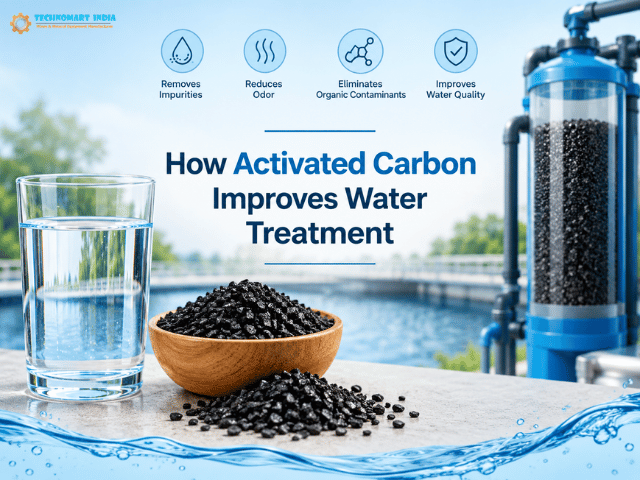
How Activated Carbon Improves Water Treatment
How Activated Carbon Improves Water Treatment is an important topic for industries, municipalities, commercial facilities, and water purification professionals looking for effective methods to improve water quality. Activated carbon is widely used because its highly porous structure can adsorb many dissolved organic compounds, taste- and odor-causing substances, chlorine, and other unwanted contaminants. By integrating activated carbon into a suitable treatment process, water treatment systems can achieve better quality, improved appearance, and enhanced suitability for further purification or use.
What Is Activated Carbon?
Activated carbon is a carbon-rich material processed to develop a large number of microscopic pores. These pores create an exceptionally high internal surface area, allowing activated carbon to attract and hold certain contaminants through adsorption. Activated carbon can be produced from raw materials such as coconut shells, coal, wood, and other carbonaceous materials.
The performance of activated carbon depends on its raw material, activation method, pore structure, particle size, and operating conditions. Different grades are therefore selected for different water treatment applications. Granular activated carbon, powdered activated carbon, and pelletized forms are commonly used depending on the system design.
How Activated Carbon Improves Water Treatment
How Activated Carbon Improves Water Treatment can be understood by looking at adsorption. When contaminated water passes through an activated carbon bed, many dissolved compounds move toward the carbon surface and become attached to its pores. This reduces the concentration of targeted contaminants in the treated water.
How Activated Carbon Improves Water Treatment is particularly valuable when water contains organic compounds that are difficult to remove using basic filtration alone. Activated carbon can act as an important polishing stage after processes such as coagulation, sedimentation, and conventional filtration.
1. Removes Unwanted Organic Compounds
One of the major reasons How Activated Carbon Improves Water Treatment is important is its ability to adsorb many organic compounds. These may contribute to unpleasant taste, odor, color, or other water-quality concerns. Activated carbon can help reduce a wide range of dissolved organic substances, depending on the carbon grade and treatment conditions.
2. Reduces Taste and Odor
Taste and odor can affect the acceptability of drinking and process water. Natural organic matter, certain industrial compounds, and other substances can create undesirable smells or tastes. Activated carbon is frequently used to reduce these compounds.
This is another practical example of How Activated Carbon Improves Water Treatment. In practical water purification projects, How Activated Carbon Improves Water Treatment also depends on choosing the right carbon grade. By adsorbing odor-producing substances, carbon filtration can provide water with improved sensory quality. Proper pretreatment and regular monitoring are important to maintain performance.
3. Helps Remove Chlorine
Activated carbon is commonly used to reduce free chlorine from water. Chlorine is valuable as a disinfectant, but excessive residual chlorine may be undesirable in certain downstream processes. It can also affect taste and odor.
How Activated Carbon Improves Water Treatment in this situation involves adsorption and chemical reactions at the carbon surface. Dechlorination systems are often placed before sensitive downstream equipment, membranes, or processes where chlorine could interfere with performance.
4. Supports Better Water Clarity and Quality
Activated carbon is not a replacement for every filtration process, but it can contribute to overall water quality when integrated correctly. Removing dissolved organic substances and color-causing compounds can make treated water more acceptable and can reduce the contaminant load placed on downstream treatment stages.
Understanding How Activated Carbon Improves Water Treatment helps engineers select the right position for a carbon filter within a complete treatment train. This planning approach shows why How Activated Carbon Improves Water Treatment should be evaluated alongside the complete process.
5. Protects Downstream Treatment Processes
Water treatment usually involves several stages rather than one single technology. Activated carbon can be used as a pretreatment or polishing step to reduce specific contaminants before water reaches another process.
For example, reducing chlorine can help protect certain membrane systems, while reducing organic compounds can improve the performance of subsequent treatment stages. This makes How Activated Carbon Improves Water Treatment relevant not only to final water quality but also to system protection.
Applications of Activated Carbon in Water Treatment: How Activated Carbon Improves Water Treatment
How Activated Carbon Improves Water Treatment becomes clearer when its applications are considered across different sectors. Activated carbon systems are used in drinking water treatment, industrial water purification, wastewater treatment, food and beverage processing, pharmaceutical manufacturing, chemical industries, and many other applications.
In municipal water treatment, activated carbon can be used to address taste, odor, natural organic matter, and selected micropollutants. In industrial facilities, carbon filters may be designed for specific process-water requirements. In wastewater treatment, activated carbon can provide additional polishing after biological or physical-chemical treatment.
Activated carbon is also useful in applications where water needs to meet strict quality requirements before being reused or discharged. The exact performance depends on the contaminant, concentration, contact time, temperature, pH, carbon properties, and flow conditions.
Types of Activated Carbon Used in Water Treatment and How Activated Carbon Improves Water Treatment
Granular activated carbon is widely used in fixed-bed filters. Water flows through a packed bed of carbon, and contaminants are adsorbed as the water contacts the carbon surface. GAC systems are suitable for continuous treatment and can be designed for different flow rates.
Powdered activated carbon is supplied as a fine powder and can be dosed directly into a treatment process. It is useful when flexible dosing is required or when contaminants need to be addressed for a specific period.
Pelletized activated carbon is manufactured into uniform shapes that can provide favorable flow characteristics and mechanical strength in certain applications.
The selection of carbon should be based on water analysis and treatment objectives rather than simply choosing the most expensive product. A qualified Activated carbon plant manufacturer can help with suitable production and system considerations for industrial-scale requirements.
Role of an Activated Carbon Plant Manufacturer
An Activated carbon plant manufacturer plays an important role in producing the equipment required to manufacture activated carbon with controlled characteristics. The activation process influences pore development, surface area, hardness, and adsorption performance.
An experienced Activated carbon plant manufacturer understands that different raw materials and end-use requirements can require different process configurations. Plant design may include crushing, screening, carbonization, activation, cooling, handling, storage, and packing systems.
A reliable activated carbon plant manufacturer can also consider production capacity, energy consumption, automation, dust management, material handling, and safety requirements. These factors influence the efficiency and consistency of an activated carbon production facility.
When selecting an Activated carbon plant manufacturer, businesses should consider engineering capability, equipment quality, customization, installation support, commissioning, and after-sales service. The right Activated carbon plant manufacturer also helps align equipment with production goals.
How Activated Carbon Improves Water Treatment Efficiency
How Activated Carbon Improves Water Treatment is not limited to contaminant removal. A properly designed carbon stage can improve the efficiency of the complete treatment process by reducing the burden on downstream units.
For example, if a carbon filter removes substances that could foul a downstream membrane, the membrane may operate more effectively. If it reduces compounds responsible for odor or color, the final treatment stage may require less corrective processing.
However, activated carbon must be correctly sized. Empty bed contact time, hydraulic loading, carbon depth, contaminant concentration, temperature, pH, and flow rate can influence adsorption performance. Poorly designed systems may lead to rapid breakthrough and unsatisfactory treatment.
Carbon Filter Design Considerations
A successful activated carbon system begins with understanding the water chemistry. Before selecting a filter, operators should identify the contaminants that need to be reduced and determine their concentrations.
Important design considerations include carbon type, bed depth, flow rate, contact time, pressure drop, operating cycle, backwashing requirements, and replacement or regeneration strategy.
How Activated Carbon Improves Water Treatment depends heavily on these parameters. For this reason, How Activated Carbon Improves Water Treatment should be assessed using actual water-quality data.
Laboratory testing or pilot trials can be useful for applications with complex contaminants or high treatment requirements. Testing helps determine adsorption capacity and expected service life before full-scale installation.
Maintenance and Carbon Replacement
Even high-quality activated carbon has a finite adsorption capacity. Once the available adsorption sites become occupied, contaminants can begin to pass through the filter. This condition is known as breakthrough.
Regular monitoring is therefore essential. Operators may track pressure drop, flow, chlorine levels, organic contaminants, taste, odor, or other application-specific indicators.
How Activated Carbon Improves Water Treatment over the long term depends on proper maintenance. Consistent monitoring is central to How Activated Carbon Improves Water Treatment. Carbon beds may need replacement, reactivation, or regeneration depending on the system and carbon type. Backwashing may also be required for certain granular systems to control accumulated solids and maintain hydraulic performance.
Benefits of Working With an Experienced Activated Carbon Plant Manufacturer
A capable Activated carbon plant manufacturer can provide more than individual equipment. The right Activated carbon plant manufacturer also helps align equipment with production goals. The manufacturer can help develop an integrated production solution based on raw materials, capacity, product specifications, and operational requirements.
A professional Activated carbon plant manufacturer may support feasibility studies, engineering, equipment manufacturing, plant installation, commissioning, and operator guidance. This integrated approach can reduce project coordination challenges.
For companies planning a new activated carbon production facility, choosing the right Activated carbon plant manufacturer can influence How Activated Carbon Improves Water Treatment applications and also affect plant reliability, product consistency, operating costs, and future expansion possibilities.
Environmental and Industrial Importance
How Activated Carbon Improves Water Treatment also has broader environmental importance. The discussion of How Activated Carbon Improves Water Treatment is therefore relevant to sustainability. Better water treatment can support water reuse, reduce pollution loads, and improve the quality of water supplied for different purposes.
In industrial facilities, effective treatment can help companies meet process-water specifications and wastewater requirements. In water reuse systems, activated carbon can be used as one component of a multi-stage treatment process to reduce selected dissolved contaminants.
Activated carbon should always be considered as part of a complete treatment strategy. It does not remove every type of contaminant, and it should not be treated as a universal solution. Suspended solids, dissolved salts, microorganisms, hardness, and other contaminants may require different technologies.
Why Technomart India Is a Reliable Choice
Technomart India has experience in designing and manufacturing industrial equipment and process plants for different applications. With engineering-focused capabilities and experience in turnkey projects, the company supports customers from project feasibility and equipment design through installation, commissioning, and after-sales support.
For businesses evaluating an Activated carbon plant manufacturer, project-specific engineering is important. Production capacity, raw materials, final carbon specifications, energy requirements, automation, and plant layout should all be evaluated before selecting equipment.
As an Activated carbon plant manufacturer, Technomart India focuses on practical plant solutions designed around customer requirements. The company can support industrial projects with equipment and engineering considerations required for establishing an activated carbon production facility.
Conclusion
How Activated Carbon Improves Water Treatment can be seen in its ability to adsorb many unwanted dissolved compounds and improve important aspects of water quality. From taste and odor reduction to chlorine removal and organic contaminant control, activated carbon can play a valuable role in a wide range of treatment systems.
The effectiveness of How Activated Carbon Improves Water Treatment depends on selecting the right carbon, designing the correct contact system, maintaining suitable operating conditions, and monitoring breakthrough. When combined with other treatment technologies, activated carbon can provide an effective polishing or pretreatment stage.
For businesses looking to establish or expand activated carbon production, partnering with an experienced Activated carbon plant manufacturer can simplify equipment selection and plant development. An experienced Activated carbon plant manufacturer can help align plant capacity, raw materials, activation technology, automation, and operating requirements.
Technomart India provides industrial plant and equipment solutions with a focus on engineering, manufacturing, installation, commissioning, and customer support. If you are planning an activated carbon production facility or exploring water treatment applications, a professionally designed solution can help improve operational reliability and long-term performance.
How Activated Carbon Improves Water Treatment remains a practical subject for industries seeking dependable adsorption-based purification. With proper engineering, How Activated Carbon Improves Water Treatment can support consistent water quality across many applications.
To learn more about the Activated Carbon Plant Manufacturer, explore our related blogs:
-
Best Activated Carbon Manufacturer in India: Read More